

In the world of heavy-duty material handling, precision and safety are non-negotiable. Whether you are managing a busy automotive workshop, a construction site, or a manufacturing plant, a 4 ton chain hoist provides the essential muscle needed to lift loads with confidence. This capacity is a "sweet spot" for many industrial applications, offering a robust balance between compact size and significant lifting power. In this guide, we will explore the technical nuances, safety requirements, and selection criteria to ensure you invest in a lifting solution that maximizes productivity while keeping your workforce safe.
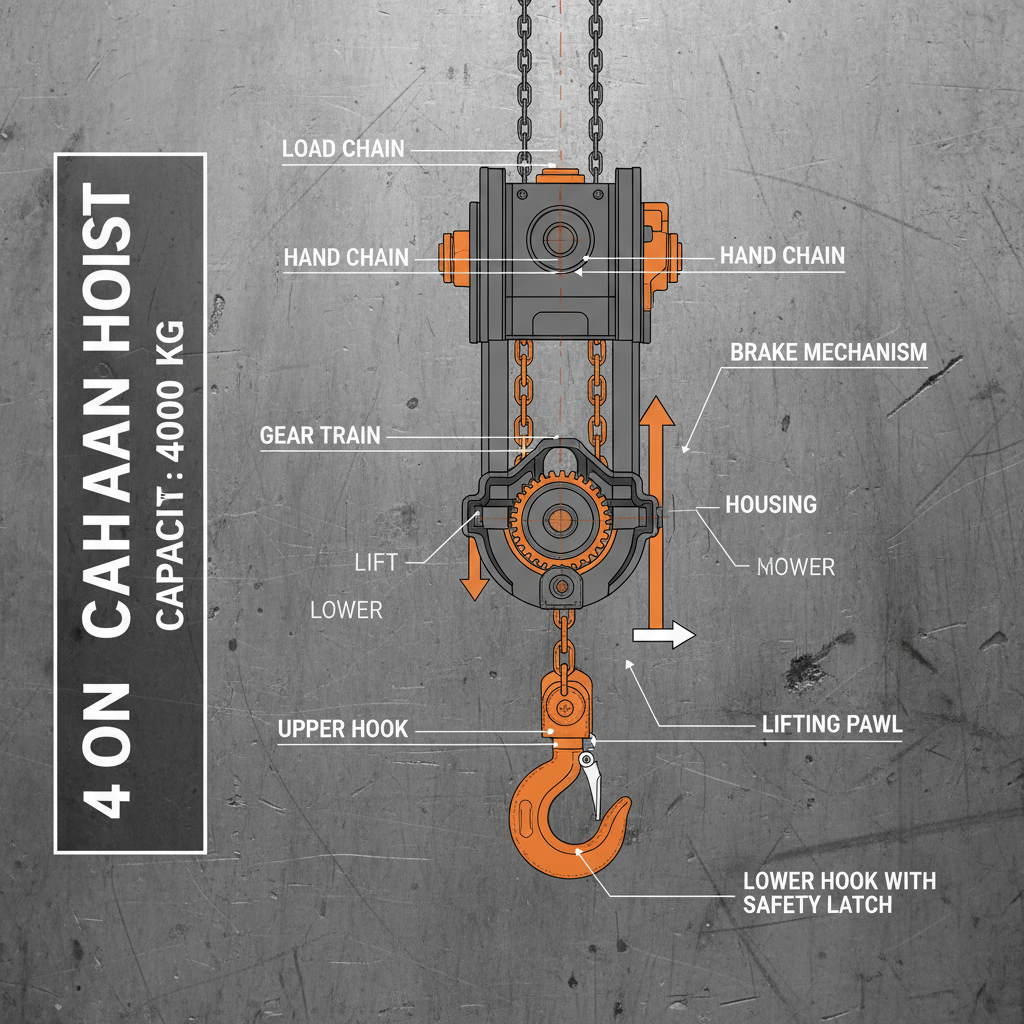
At its heart, a 4 ton chain hoist operates on a mechanical advantage system, typically utilizing a series of gears and a heavy-duty load chain. These devices are available in both manual and electric configurations. Manual hoists rely on a hand chain to drive the mechanism, making them ideal for locations without power or for occasional lifts. Electric hoists, on the other hand, prioritize speed and operator comfort, reducing physical fatigue during repetitive cycles. The critical component is the grade 80 or grade 100 alloy steel chain, which is heat-treated to ensure it can withstand the immense tension of a 4,000kg load without stretching or snapping. By choosing a high-quality 4 ton chain hoist, you ensure that the gear engagement is smooth and the braking system is fail-safe.
Pro Tip: Always check the "Working Load Limit" (WLL). A 4-ton hoist is rated for exactly that; exceeding this limit by even a small percentage can compromise the structural integrity of the hoist and lead to catastrophic failure.
Deciding between a manual and an electric 4 ton chain hoist depends entirely on your operational frequency and environment. Manual hoists are prized for their portability and lack of dependence on an electrical grid, whereas electric hoists are the gold standard for high-throughput production lines. When comparing the two, factors such as lifting speed, installation cost, and maintenance requirements come into play. Below is a detailed comparison to help you determine which system fits your specific workflow.
The versatility of a 4 ton chain hoist makes it a staple across multiple sectors. In the automotive industry, it is frequently used for engine removal and transmission swaps in heavy trucks. In manufacturing, it assists in the assembly of medium-sized machinery or the movement of heavy molds. Additionally, warehousing operations utilize these hoists for vertical storage of heavy crates or equipment maintenance. Because the 4 ton chain hoist provides a precise lift, it is also preferred in precision engineering where "inching" a load into place is critical for alignment.
Safety is the most critical aspect of operating any lifting equipment. A 4 ton chain hoist must be operated according to strict guidelines to prevent accidents. This includes performing a pre-use inspection to check for chain wear, twisted links, or hooks that have opened up. Load-testing is also mandatory; the hoist should be tested with a certified weight to ensure the braking mechanism holds firmly. Regular lubrication of the load chain is essential to prevent friction-induced wear and tear, which can significantly shorten the equipment's lifespan.
Safety Checklist:
• Inspect chain for cracks or deformation before every lift
• Ensure the hook safety latch is fully functional
• Never leave a suspended load unattended
• Verify the mounting structure can support 4 tons plus the hoist weight
When reviewing technical data, you will notice that a high-quality 4 ton chain hoist is defined by its build materials and load-bearing tolerances. The chain diameter is specifically calibrated to handle the 4,000kg load, and the housing is typically constructed from reinforced steel to protect the internal gearing from dust and impact. Understanding these specs allows procurement managers to ensure they are buying equipment that meets international safety certifications like CE or ASME.
Implementing a 4 ton chain hoist is not just about the hardware; it is about integrating it into a larger efficiency strategy. For many businesses, combining a hoist with a trolley system allows for both vertical and horizontal movement, creating a semi-automated material handling bridge. This reduces the need for forklifts in tight spaces and minimizes the risk of manual handling injuries. When choosing your provider, look for a company that offers not only the equipment but also the technical support and certifications necessary to ensure your operations remain compliant and efficient.
Investing in a professional-grade 4 ton chain hoist is a strategic move for any business dealing with heavy loads. By balancing capacity, safety, and the right drive mechanism (manual vs. electric), you can significantly enhance your operational throughput while safeguarding your employees. Remember that the cheapest option is rarely the safest; prioritize certified materials and rigorous testing to ensure long-term reliability. Elevate your workspace with a solution that blends power with precision.
To determine if a 4-ton hoist is appropriate, you must first calculate the total weight of the object being lifted, including any rigging gear (slings, shackles, or spreader beams). If the total weight is comfortably under 4,000kg, this hoist is suitable. However, it is industry best practice to operate at 80% of the maximum capacity for daily use to reduce wear. If your load consistently hits 4 tons, you may want to consider a 5-ton model to provide a safety buffer and extend the life of the chain and gears.
The "Grade" refers to the tensile strength of the alloy steel. Grade 100 chain is stronger and more durable than Grade 80, meaning it can often be thinner while supporting the same load, or it can offer a higher safety factor for the same diameter. In a 4 ton hoist, using Grade 100 chain typically results in a more lightweight unit and better resistance to wear and tear, making it the preferred choice for high-intensity industrial environments where reliability is paramount.
Inspection should happen in three tiers: Daily, Monthly, and Annually. A daily visual check should ensure the chain isn't twisted and the hook latch works. A monthly inspection should involve checking for chain wear using a caliper and lubricating the chain. An annual professional certification is mandatory, where a qualified engineer performs a load test and a thorough internal gear inspection. Following this schedule ensures that your 4 ton chain hoist remains safe and compliant with local safety laws.
No, chain hoists are designed strictly for vertical lifting. Side-pulling (lifting at an angle) puts uneven stress on the load chain and the internal gears, which can cause the chain to jump out of the sprocket or cause the hoist to swing violently once the load leaves the ground. If you need to move a load horizontally, you should use a hoist combined with a trolley system or a jib crane to ensure the lift remains perfectly vertical, maintaining the safety integrity of the equipment.


 Afrikaans
 Albanian
 Amharic
 Arabic
 Armenian
 Azerbaijani
 Basque
 Belarusian
 Bengali
 Bosnian
 Bulgarian
 Catalan
 Cebuano
 China
China
 China (Taiwan)
 Corsican
 Croatian
 Czech
Czech
 Danish
 Dutch
Dutch
 Esperanto
 Estonian
 Finnish
 French
 Frisian
 Galician
 Georgian
 German
 Greek
Greek
 Gujarati
 Haitian Creole
 Hausa
Hausa
 Hawaiian
 Hebrew
 Hindi
Hindi
 Miao
Miao
 Hungarian
 Icelandic
 Igbo
Igbo
 Indonesian
 Irish
Irish
 Italian
 Japanese
 Javanese
 Kannada
 Kazakh
 Khmer
Khmer
 Rwandese
 Korean
 Kurdish
 Kyrgyz
 Lao
Lao
 Latin
Latin
 Latvian
 Lithuanian
 Luxembourgish
 Macedonian
 Malgashi
 Malay
Malay
 Malayalam
 Maltese
 Maori
Maori
 Marathi
 Mongolian
 Myanmar
 Nepali
 Norwegian
 Norwegian
 Occitan
 Pashto
 Persian
 Polish
 Portuguese
 Punjabi
 Romanian
 Russian
 Samoan
 Scottish Gaelic
 Serbian
 Sesotho
 Shona
Shona
 Sindhi
 Sinhala
 Slovak
 Slovenian
 Somali
 Spanish
 Sundanese
 Swahili
 Swedish
 Tagalog
 Tajik
Tajik
 Tamil
Tamil
 Tatar
Tatar
 Telugu
 Thai
Thai
 Turkish
 Turkmen
 Ukrainian
 Urdu
Urdu
 Uighur
 Uzbek
Uzbek
 Vietnamese
 Welsh
Welsh
 Bantu
Bantu
 Yiddish
 Yoruba
 Zulu
Zulu
 English